Overview
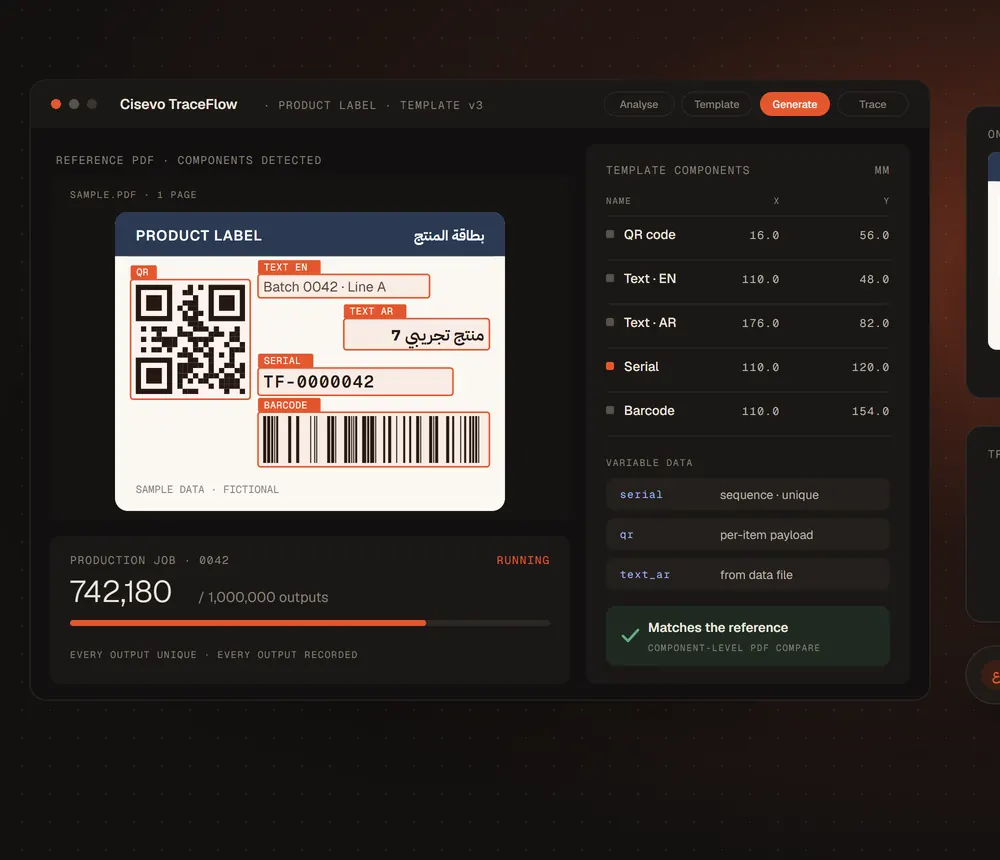
An enterprise platform for high-volume document production. It turns reference PDFs into reusable templates with precisely positioned components, fills them with unique data, serial numbers, QR codes and barcodes in Arabic and English, and keeps a record of every output it generates.
The problem
When production reaches hundreds of thousands or millions of items, every one must follow the approved design, carry its own correct data, keep QR codes, barcodes and serials unique and in exactly the right place — and remain traceable afterwards.
Start from a document you already have
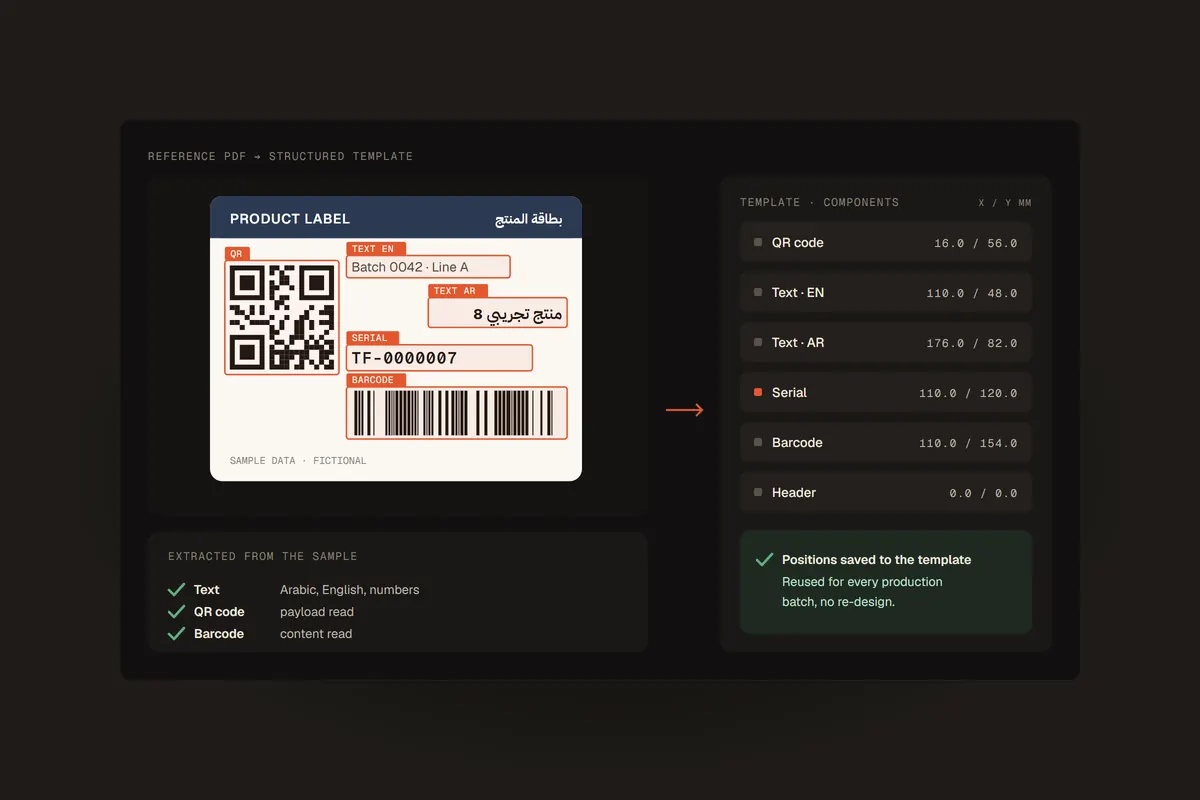
Upload a reference PDF and TraceFlow analyses it — reading Arabic, English and numeric text, QR codes and barcodes and their contents — and records where every component sits, so the layout never has to be rebuilt by hand.
- Text in Arabic, English and mixed
- QR codes and barcodes, with their payloads
- Serial numbers and identifiers
- Component positions on the page
Templates with exact positions
Each component is saved with precise X and Y coordinates in a reusable template, together with the document size and the fields that change per item. The same approved structure is reproduced in every batch.
Every output different, every design the same
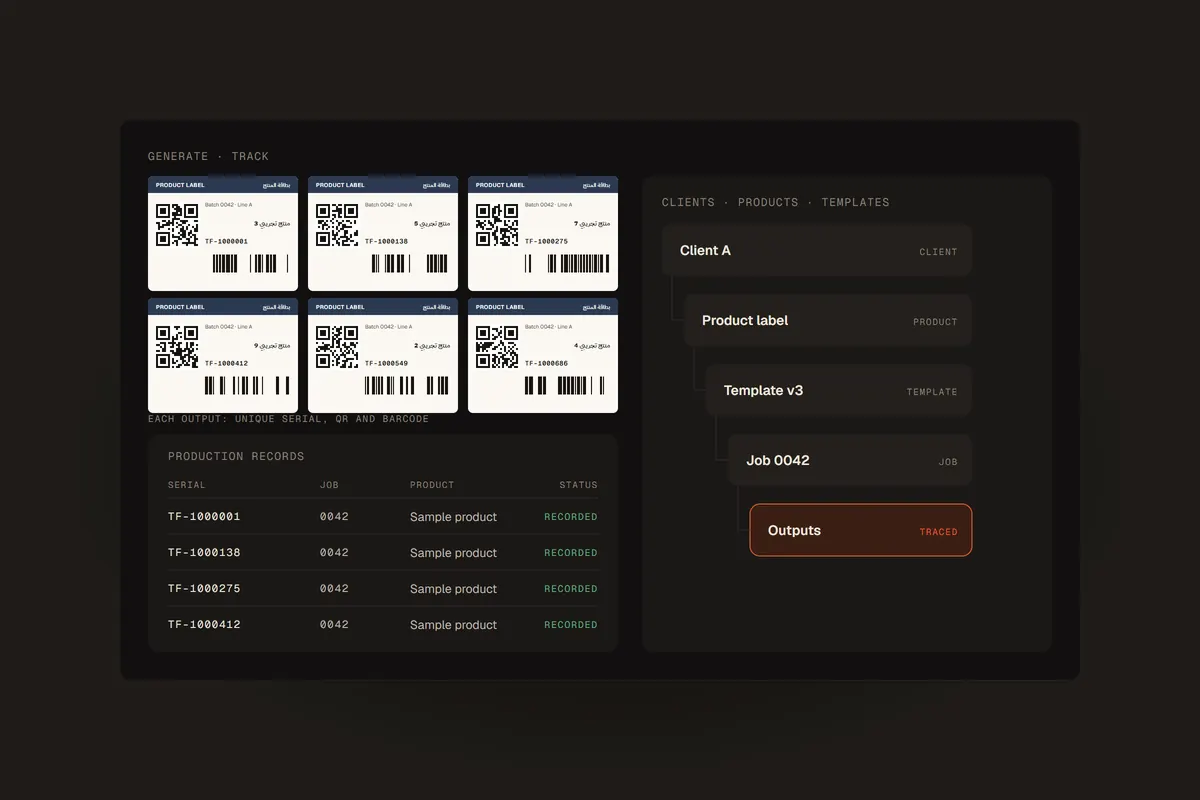
Templates are filled with variable data for each output: unique serial numbers, product and customer information, Arabic and English text, and dynamic QR and barcode content placed exactly where the template defines.
Built for millions
Batch generation is designed for workloads of millions of personalised outputs and has been used at that scale. Arabic shaping, direction and mixed-language ordering are handled throughout.
Compare, then trust
Generated PDFs can be compared with the reference at component level — text, QR codes, barcodes and positions — to confirm a template before full production.
Traceable from client to output
Clients, products, templates, production jobs and generated records are managed centrally, so every serial number, QR code and barcode stays linked to the job, product and client it belongs to.
Illustrations use fictional sample data; client documents, payloads and serial-number formats are not shown. No throughput figures are published until benchmarks are approved; ERP integrations are a future direction.